
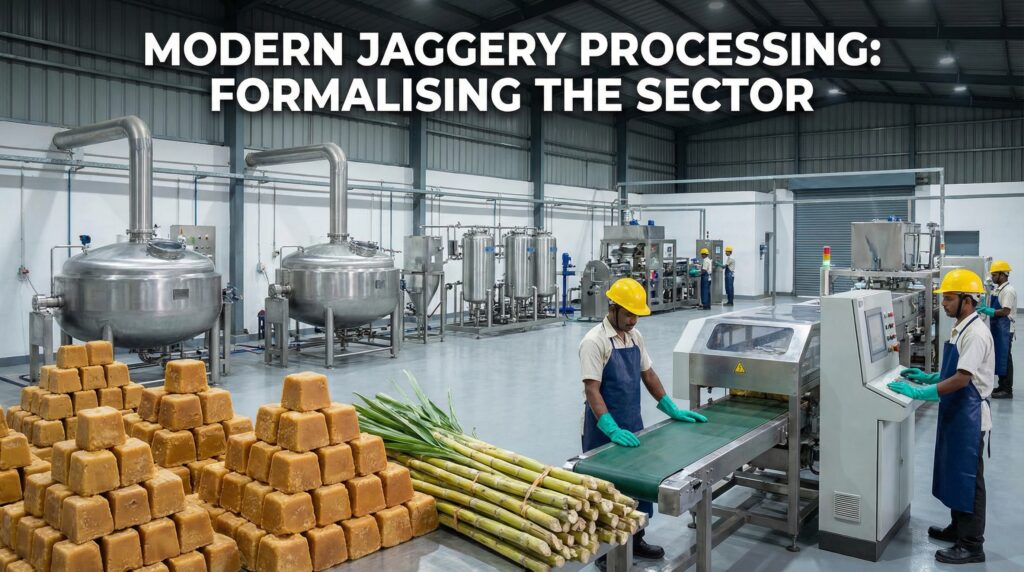
The Ministry of Food Processing Industries (MoFPI) has intensified its push to modernise India’s jaggery sector by rolling out targeted financial incentives and infrastructure support for processing units across the country.
Under flagship schemes such as Pradhan Mantri Kisan SAMPADA Yojana (PMKSY), the Production Linked Incentive Scheme for Food Processing Industry (PLISFPI) and the Pradhan Mantri Formalisation of Micro Food Processing Enterprises (PMFME), the ministry is backing the establishment and expansion of modern jaggery processing units with a focus on technology upgradation and quality enhancement. These interventions are aimed at driving adoption of improved processing technologies, improving product consistency, and ensuring alignment with Food Safety and Standards Authority of India (FSSAI) norms to unlock better domestic and export opportunities.
As of December 31, 2025, MoFPI has sanctioned support for five modern jaggery processing units under the Creation/Expansion of Food Processing & Preservation Capacities (CEFPPC) component of PMKSY, with total grants of Rs 17.07 crore. In addition, 3,528 micro food processing enterprises focusing on jaggery have been approved for subsidies worth Rs 102.31 crore under the PMFME scheme, signalling a strong policy thrust towards formalising and scaling this traditionally unorganised segment.
To deepen value addition and strengthen local value chains, the government is also promoting jaggery and related products under the One District One Product (ODOP) framework in 19 districts. This approach is designed to help enterprises benefit from economies of scale, common services, and improved branding and marketing platforms. Under PMFME, collectives such as Farmer Producer Organisations (FPOs), Self-Help Groups (SHGs) and cooperatives are eligible for grants of up to 50 per cent for branding and marketing activities, enabling them to compete more effectively in both domestic and export markets.
Officials note that these focused interventions on infrastructure, technology and market development are expected to lift quality standards, reduce post-harvest losses and catalyse growth in the jaggery value chain as well as the broader food processing industry. The push is also projected to generate rural employment and improve farmer incomes by creating stronger, more resilient linkages between sugarcane growers, processors and markets.